Showing posts with label developing_countries. Show all posts

Thursday, 20 January 2011

Microfinance resources on the Internet - Information on institutions and regulatory measures for some countries

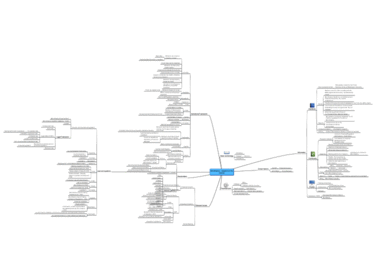
Clicking on the picture below you could access a mindmap providing information and links on the legal and institutional framework established in some developing countries to regulate the activities of microfinance institutions. The map has been developed using Mindmeister, one of the most popular web 2.0 site for publishing these diagrams on the Web.
Do the examined countries have a specific law to regulate the sector or request a particular legal status for these institutions to operate in the market? at the institutional level, there are ad hoc agencies or simply  ministerial departments administering the industry?


Hope you could find at least some of the answers there...


Saturday, 1 January 2011

Successful trade between European Union and developing countries

Logo PIP

COLEAP network promotes sustainable horticultural trade solutions, gathering together producers and exporters from the ACP countries and EU importers of fruit, vegetables, flowers and ornamental plants and other partners and companies operating in the horticultural industry. The cooperation programme PIP managed by COLEAP, financed by the European Development Fund is active in a number of  ACP countries. Information on the local directory of  exporters is available on the PIP site hyperlinked in the following map:

PIP directory

Grace Mueni Nyaa, from Kenya,founder of the Kyome Fresh Company Limited participated to the programme and talked about her experience at the European Development Days 2010. The Kenyan company grew from the initial capital base of €2600 to €140.000 in seven years down the line with an average annual sales turnover of €1.6 million! This sample highlights the importance of the private sector as one of the  main drivers for economic growth in developing countries and in particular small and medium enterprises. More information on the role of SME in developing countries are available in the following presentation:


Sunday, 19 December 2010

Mobile phones and broadband subscriptions in developing countries

The International Telecommunication Union (ITU) the UN agency established to promote  the development of networks and services for information and communication technology released interesting statistical data on mobile phones sales and Internet access via broadband  connection. With regards to cell phones sales, the 3G technology is increasing its market share both in developed and developing countries. Main difference between 2G and 3G network resides in the faster data speeds offered by 3G. The 3G standard allows data, pictures and videos to be uploaded and downloaded quickly, while for voice use and text messaging, the differences between the two standards is minimal.
The developing world is increasing its share of mobile subscriptions from 53% of total mobile subscriptions at the end of 2005 to 73% at the end of 2010. In particular, countries like China and India and others in the Asia Pacific region are leading this growth.
The situation is still critical in Africa. While 71% of the population in developed countries are online, Internet user penetration in Africa will reach in 2010 only 9.6%, far behind both the world average (30%) and the developing country average (21%).

Further details on the access to the Internet are available on the Internet World Stats site.