- Transparency and disclosure in lending practices and initiatives to improve financial literacy.
- Types of collaterals collected and procedures of enforcement.
- Initiatives to prevent overindebtedness and limit multiple lending (like credit information databases)
- R ecovery loans mechanisms
- Availability and accessibility of redress mechanisms to the consumer.
Showing posts with label legislation. Show all posts
Monday, 7 February 2011
Microfinance industry - the case of Pakistan
The article Pakistan: a protected microfinance borrower? written by Arsala Kidwai from the International Development Law Organization - IDLO provides an insight of the legislation enforced to regulate MFIs activities in the country. The paper monitors and evaluates laws and regulations in place in Pakistan against a number of indicators (listed below) to state rights and warranties of microfinance customers.
Labels:
legislation,
microfinance,
Pakistan
Wednesday, 2 February 2011
Hidden charges, financial literacy, quasi-monopoly market demand more regulations in microfinance
Main issues requiring government regulations in the microcredit sector:
1 - Quasi monopolistic market: microcredit organizations do not operate in free and competitive markets but operate business in often quasi-monopolies. Furthermore, according to specialists: competition is only on non-price terms (Nimal Fernando, Asian Bank for Development).
2 - Low Financial Literacy: Wrong assumption that microcredit clients are rational economic actors. On the contrary, as demonstrated by the recent global financial crisis, also developed countries need to increase consumer protection legislation. In the United States, for instance, the Obama administration, enforced The Credit Card Accountability Responsability and Disclosure Act of 2009 and in 2010 established the Consumer Financial Protection Bureau to protect consumers of financial services from abusive, deceptive and unfair practices.
3 - Lack of Transparency: Transparency is another key point. Consumers should be put in the conditions to choose the right product after comparing effective interest rates and loan terms. Malpractices such the ones below transform loans from opportunities to obligations:
up-front fees, compulsory savings, insurance premium subscription; distorted calculation of the interest rates (usually based on the original loan and not on the residual amount of debt). Professor Subrata Mitra from the Indian Institute of Management in Calcutta, describes in his article Exploitative Microfinance Interest Rates how these tricks litteraly blow up the effective rates.
for more information on these issues you can read the article by Prof. Aneel Karnani published on the Stanford Social Innovation Review entitled Microfinance needs regulation
1 - Quasi monopolistic market: microcredit organizations do not operate in free and competitive markets but operate business in often quasi-monopolies. Furthermore, according to specialists: competition is only on non-price terms (Nimal Fernando, Asian Bank for Development).
2 - Low Financial Literacy: Wrong assumption that microcredit clients are rational economic actors. On the contrary, as demonstrated by the recent global financial crisis, also developed countries need to increase consumer protection legislation. In the United States, for instance, the Obama administration, enforced The Credit Card Accountability Responsability and Disclosure Act of 2009 and in 2010 established the Consumer Financial Protection Bureau to protect consumers of financial services from abusive, deceptive and unfair practices.
3 - Lack of Transparency: Transparency is another key point. Consumers should be put in the conditions to choose the right product after comparing effective interest rates and loan terms. Malpractices such the ones below transform loans from opportunities to obligations:
up-front fees, compulsory savings, insurance premium subscription; distorted calculation of the interest rates (usually based on the original loan and not on the residual amount of debt). Professor Subrata Mitra from the Indian Institute of Management in Calcutta, describes in his article Exploitative Microfinance Interest Rates how these tricks litteraly blow up the effective rates.
for more information on these issues you can read the article by Prof. Aneel Karnani published on the Stanford Social Innovation Review entitled Microfinance needs regulation
Monday, 31 January 2011
India towards more stringent and clear regulations in the microfinance sector ?
The Reserve Bank of India (RBI) has published few days ago on its website the Report of the study on the microfinance sector made by the
Sub-Committee of the Central Board of Directors. The RBI panel chaired by Mr. Yedzi H. Malegam was established in response to the Andhra Pradesh rules, which severely curtailed microfinance activities in the state, curbed collections and hurt new businesses.
The stock of SKS Microfinance, the main microfinance institution in India, which is based in Hyderabad, the capital of Andhra Pradesh, has fallen about 30 percent since October when the state's new microfinance rules came into effect.
The Panel has made a number of recommendations to mitigate the problems of multiple-lending, over borrowing, ghost borrowers and coercive methods of recovery. It seems financial authorities in India are in line with Yunus's article on the future development of the sector. Some of the main recommendations are listed hereafter:
- 1. Creation of a separete category of microfinance institutiones classified as Non-Banking Financial Company (NBFC-MFI). These institutes will hold not less than 90% of its total assets (other than cash and bank balances and money market instruments) in the form of qualifying assets.

- 2. There are limits of an annual family income of Rs.50,000 and an individual ceiling on loans to a single borrower of Rs.25,000.
- 3. Not less than 75% of the loans given by the MFI should be for income-generating purposes.
- 4. There is a restriction on the other services to be provided by the MFI which has to be in accordance with the type of service and the maximum percentage of total income as may be prescribed.
- 5. With regard to the interest chargeable to the borrower, the Sub-Committee has recommended an average “margin cap” of 10 per cent for MFIs having a loan portfolio of Rs. 100 crore and of 12 per cent for smaller MFIs and a cap of 24% for interest on individual loans. It has also proposed that, in the interest of transparency, an MFI can levy only three charges, namely, (a) processing fee (b) interest and (c) insurance charge.
- 6. A borrower can be a member of only one Self-Help Group (SHG) or a Joint Liability Group (JLG).
- 7. Not more than two MFIs can lend to a single borrower.
- 8. There should be a minimum period of moratorium between the disbursement of loan and the commencement of recovery.
- 9.The tenure of the loan must vary with its amount.
- 10. A Credit Information Bureau has to be established.
-11. The primary responsibility for avoidance of coercive methods of recovery must lie with the MFI and its management.
-12. The Reserve Bank must prepare a draft Customer Protection Code to be adopted by all MFIs.
- 13. There must be grievance redressal procedures and establishment of ombudsmen.
- 14. All MFIs must observe a specified Code of Corporate Governance.
SKS Microfinance Chief Financial Officer S. Dilliraj said "The panel's recommendations "clears the regulatory ambiguity that existed in the microfinance sector since the promulgation of the Andhra Pradesh Microfinance Ordinance". The fast-growing Indian microfinance sector suffered a setback late last year when the state of Andhra Pradesh, which had the largest microfinance market in India, approved legislation to regulate the industry following complaints about high interest rates, aggressive recovery practices and overextended borrowers.
Some links with further information:
Sub-Committee of the Central Board of Directors. The RBI panel chaired by Mr. Yedzi H. Malegam was established in response to the Andhra Pradesh rules, which severely curtailed microfinance activities in the state, curbed collections and hurt new businesses.
The stock of SKS Microfinance, the main microfinance institution in India, which is based in Hyderabad, the capital of Andhra Pradesh, has fallen about 30 percent since October when the state's new microfinance rules came into effect.
The Panel has made a number of recommendations to mitigate the problems of multiple-lending, over borrowing, ghost borrowers and coercive methods of recovery. It seems financial authorities in India are in line with Yunus's article on the future development of the sector. Some of the main recommendations are listed hereafter:
- 1. Creation of a separete category of microfinance institutiones classified as Non-Banking Financial Company (NBFC-MFI). These institutes will hold not less than 90% of its total assets (other than cash and bank balances and money market instruments) in the form of qualifying assets.

- 2. There are limits of an annual family income of Rs.50,000 and an individual ceiling on loans to a single borrower of Rs.25,000.
- 3. Not less than 75% of the loans given by the MFI should be for income-generating purposes.
- 4. There is a restriction on the other services to be provided by the MFI which has to be in accordance with the type of service and the maximum percentage of total income as may be prescribed.
- 5. With regard to the interest chargeable to the borrower, the Sub-Committee has recommended an average “margin cap” of 10 per cent for MFIs having a loan portfolio of Rs. 100 crore and of 12 per cent for smaller MFIs and a cap of 24% for interest on individual loans. It has also proposed that, in the interest of transparency, an MFI can levy only three charges, namely, (a) processing fee (b) interest and (c) insurance charge.
- 6. A borrower can be a member of only one Self-Help Group (SHG) or a Joint Liability Group (JLG).
- 7. Not more than two MFIs can lend to a single borrower.
- 8. There should be a minimum period of moratorium between the disbursement of loan and the commencement of recovery.
- 9.The tenure of the loan must vary with its amount.
- 10. A Credit Information Bureau has to be established.
-11. The primary responsibility for avoidance of coercive methods of recovery must lie with the MFI and its management.
-12. The Reserve Bank must prepare a draft Customer Protection Code to be adopted by all MFIs.
- 13. There must be grievance redressal procedures and establishment of ombudsmen.
- 14. All MFIs must observe a specified Code of Corporate Governance.
SKS Microfinance Chief Financial Officer S. Dilliraj said "The panel's recommendations "clears the regulatory ambiguity that existed in the microfinance sector since the promulgation of the Andhra Pradesh Microfinance Ordinance". The fast-growing Indian microfinance sector suffered a setback late last year when the state of Andhra Pradesh, which had the largest microfinance market in India, approved legislation to regulate the industry following complaints about high interest rates, aggressive recovery practices and overextended borrowers.
Some links with further information:
- Y. H. Malegam. Limit on annual income can be changed
- Malegam Committee Microfinance Report – Summary of Reactions from MFI Sector
- Malegam Committee Report – Summary of Key Recommendations
- Interview with Y H Malegam on his report on Indian Microfinance Institutions
- Notional loss due to Andhra ordinance: SKS Microfinance
Labels:
India,
legislation,
microfinance,
reports
Saturday, 29 January 2011
Let's bring microcredit back on track - Muhammad Yunus
"Commercialization has been a terrible wrong turn for microfinance, and it indicates a worrying “mission drift” in the motivation of those lending to the poor. Poverty should be eradicated, not seen as a money-making opportunity."
This little excerpt from the article written by Muhammad Yunus
"Sacrificing microcredit for megaprofit", on the New York Times, summarizes the problems suffered by the sector in the last years.
Many borrowers found themselves struggling with high interest rates, dealing with aggressive marketing and loan collection practices.
To go back to its origin and mission, microcredit needs to be more strictly regulated. The creation of an ad hoc regulatory authority would better ensure transparency in the sector, prevents the application of excessive interest rates and distorted loan collection practices.
This little excerpt from the article written by Muhammad Yunus
"Sacrificing microcredit for megaprofit", on the New York Times, summarizes the problems suffered by the sector in the last years.
Many borrowers found themselves struggling with high interest rates, dealing with aggressive marketing and loan collection practices.
To go back to its origin and mission, microcredit needs to be more strictly regulated. The creation of an ad hoc regulatory authority would better ensure transparency in the sector, prevents the application of excessive interest rates and distorted loan collection practices.
Labels:
articles,
legislation,
microcredit
Thursday, 20 January 2011
Microfinance resources on the Internet - Information on institutions and regulatory measures for some countries
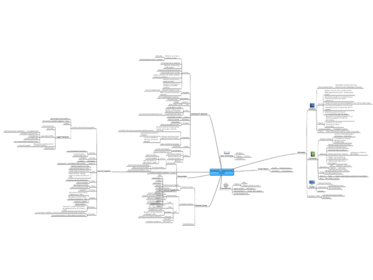
Clicking on the picture below you could access a mindmap providing information and links on the legal and institutional framework established in some developing countries to regulate the activities of microfinance institutions. The map has been developed using Mindmeister, one of the most popular web 2.0 site for publishing these diagrams on the Web.
Do the examined countries have a specific law to regulate the sector or request a particular legal status for these institutions to operate in the market? at the institutional level, there are ad hoc agencies or simply ministerial departments administering the industry?
Hope you could find at least some of the answers there...
Do the examined countries have a specific law to regulate the sector or request a particular legal status for these institutions to operate in the market? at the institutional level, there are ad hoc agencies or simply ministerial departments administering the industry?
Hope you could find at least some of the answers there...
Labels:
developing_countries,
legislation,
microfinance
Subscribe to:
Posts (Atom)